From Chatbots to Coworkers: What “AI Agent” Actually Means in the Enterprise
Every vendor demo now includes the word “agent.” Strip away the marketing and the concept is straightforward: an AI agent is a system that can plan a multi-step task, call tools or APIs to execute it, and check its own work — without a human approving every intermediate step. That last part is what separates an agent from a chatbot, and it’s also what makes governance harder.
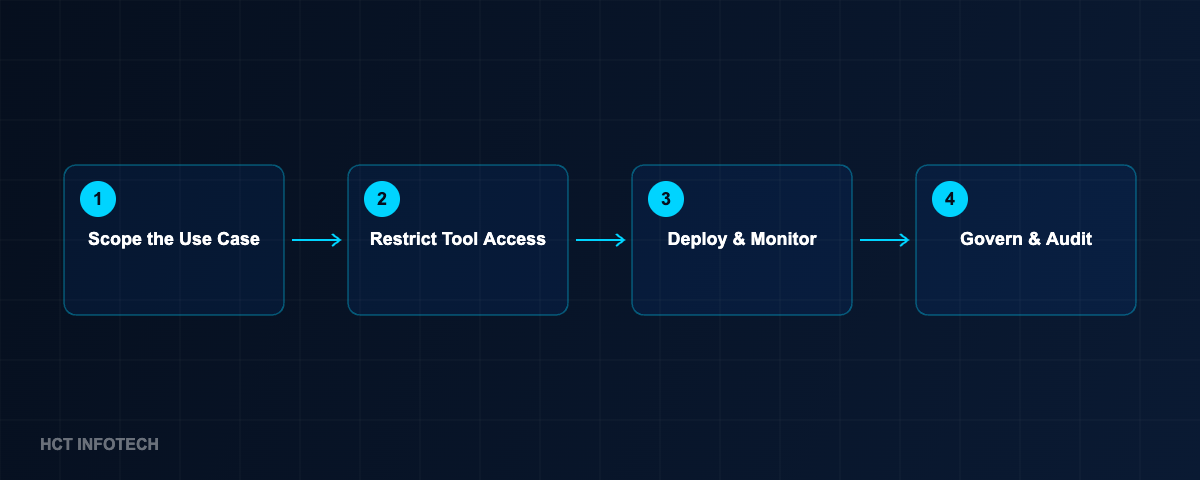
Through 2025 and into 2026, we’ve helped clients move from “AI pilot in a sandbox” to “AI agent with production access,” and the lessons have been consistent enough to write down.
Start With a Narrow, Measurable Use Case
The organizations that get the most value skip the general-purpose assistant and start with a specific, bounded workflow: triaging inbound support tickets, reconciling invoices against purchase orders, drafting first-pass incident response summaries. Narrow scope makes it possible to measure accuracy, catch failure patterns early, and build trust incrementally.
Treat Tool Access Like Any Other Privileged Account
An agent that can read your CRM is a data exposure risk. An agent that can write to your CRM, send emails, or trigger a deployment is an operational risk with a blast radius you need to define in advance. We apply the same least-privilege principles we’d use for a service account: scoped API keys, explicit allow-lists of actions, and audit logging on every tool call the agent makes. If you wouldn’t hand a new intern that level of access on day one, don’t hand it to an agent either.
Design for Graceful Failure, Not Just Success
Agents fail in ways traditional software doesn’t — they can be confidently wrong. A good agent architecture includes checkpoints where the agent surfaces uncertainty rather than guessing, escalation paths to a human when confidence is low, and rollback mechanisms for any action that isn’t easily reversible. We’ve found that the single biggest predictor of a successful agent deployment is whether the team designed the “what happens when it’s wrong” path before launch, not after an incident.
Data Quality Is the Real Bottleneck
Agents built on top of messy, inconsistent internal data inherit that mess. Before automating a workflow, we typically spend more time cleaning and structuring the underlying data — ticket taxonomies, CRM fields, document repositories — than we do on the agent logic itself. It’s less exciting than the AI part, but it’s usually the difference between a pilot that works and one that quietly gets abandoned.
Where We’re Seeing Real ROI in 2026
- IT operations: agents that triage alerts, correlate logs across systems, and draft remediation steps for on-call engineers to approve.
- Customer support: first-response drafting and knowledge base retrieval, with humans handling anything outside a defined confidence threshold.
- Finance operations: invoice matching, anomaly flagging, and reconciliation across disconnected systems.
- Software delivery: automated code review summaries, test generation, and dependency vulnerability triage.
The Governance Conversation Has to Happen Before Deployment
Every client asks the technical “can we build this” question first. The more important question is “who is accountable when it’s wrong,” and that answer needs to exist before go-live, not after. We build a lightweight AI governance framework alongside every agent deployment: what the agent is allowed to do, who reviews its outputs, how often its accuracy is audited, and what triggers a rollback to fully manual process.
AI agents are genuinely useful right now — but only for teams willing to do the unglamorous work of scoping, access control, and data hygiene first. The pilots that skip straight to “give it broad access and see what happens” are the ones that end up in a postmortem.
Thinking about deploying AI agents in your operations? We help teams scope, secure, and govern production AI systems.
