Security Can’t Be a Code Review Checkbox Anymore
For years, “secure development” meant a security team reviewing code before release and a penetration test before launch. That model assumed vulnerabilities were rare enough to catch at the end of the pipeline. With modern applications shipping dozens of times a day and pulling in hundreds of third-party dependencies, the end-of-pipeline model doesn’t scale — and it doesn’t catch the issues that matter most.
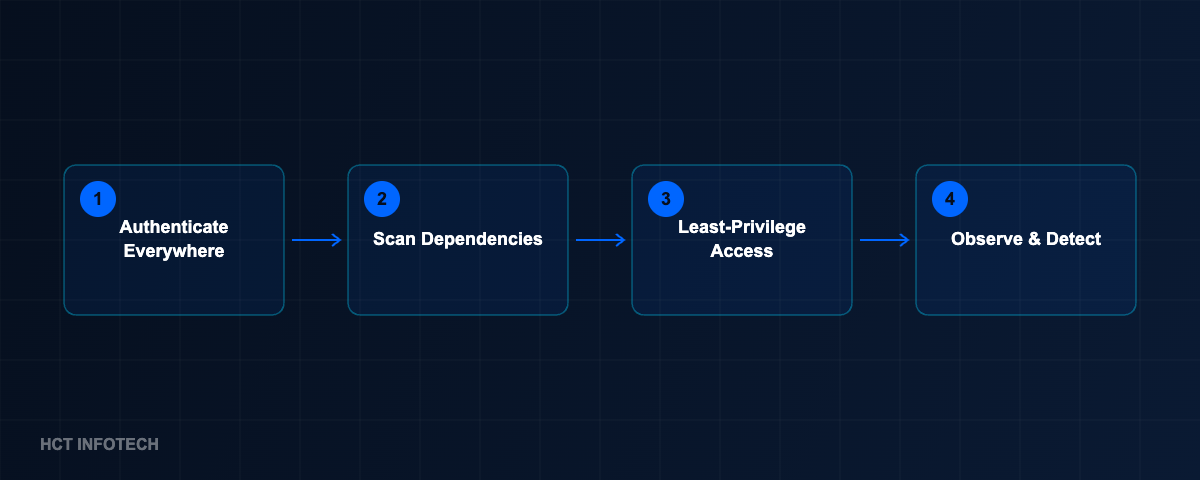
Zero Trust by design means treating every service, every dependency, and every API call as untrusted until verified — starting from the first commit, not the final review.
Principle 1: Every Service Authenticates, Even Internally
“It’s just an internal API call” is one of the most expensive sentences in software engineering. We design service-to-service communication with mutual TLS and short-lived tokens by default, regardless of whether the call crosses a network boundary a human would consider “external.” Internal doesn’t mean trusted — it means the blast radius of a compromised internal service should be no larger than the blast radius of a compromised external one.
Principle 2: Dependencies Are Attack Surface, Not Free Code
A modern application might pull in thousands of transitive dependencies. Each one is code you didn’t write, running with the permissions your application has. We build software delivery pipelines with automated dependency scanning on every commit, not just at release time, and we treat a new critical CVE in a dependency the same way we’d treat a bug report — triaged, ticketed, and patched on a defined SLA rather than “whenever someone notices.”
Principle 3: Secrets Never Live in Code, Configs, or Chat
This sounds obvious and is still one of the most common findings in every codebase audit we run. API keys committed years ago and never rotated, credentials pasted into a Slack channel during an incident, connection strings sitting in a config file that made it into version control. We implement centralized secrets management (Azure Key Vault, HashiCorp Vault, or equivalent) with automatic rotation, and we scan repository history — not just the current branch — for anything that slipped through before the policy existed.
Principle 4: Least Privilege Is a Default, Not a Cleanup Task
It’s far easier to grant a service account broad permissions once and move on than to scope permissions precisely for every new feature. We push back on this pattern in every architecture review: new services start with the minimum permission set required for their current functionality, and permission expansions require an explicit, documented justification — the same discipline we’d apply to a human user’s access request.
Principle 5: Build Observability Into the Threat Model, Not Just the Ops Dashboard
Detection speed matters as much as prevention. We design logging and monitoring around the question “if this specific component were compromised, would we know within minutes?” That means structured, centralized logs; alerting on anomalous access patterns, not just system errors; and regular tabletop exercises where the engineering team practices responding to a simulated breach before a real one happens.
What This Looks Like in Practice
Secure-by-design isn’t a separate phase bolted onto a development process — it’s a set of defaults baked into the templates, pipelines, and architecture reviews every team already uses. When we bring a client’s development process up to this standard, the goal isn’t a one-time audit; it’s making the secure path the easiest path, so teams don’t have to choose between shipping fast and shipping safely.
Want secure-by-design built into your development pipeline from day one? We help engineering teams bake in Zero Trust defaults.
